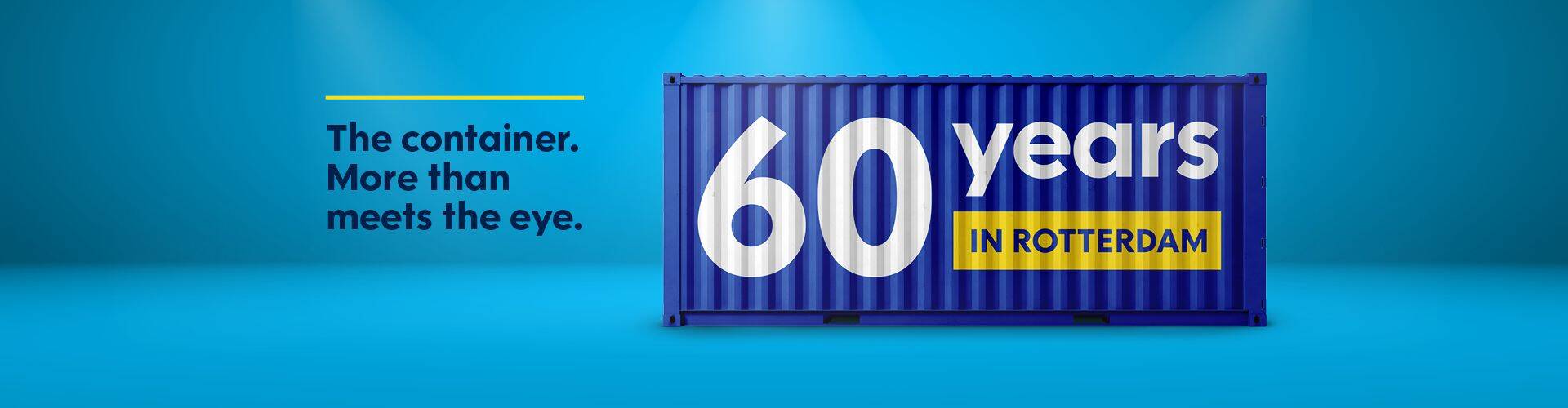
The container.
More than meets the eye.
It may well be one of the most influential objects, but we never give it a second thought: the container. It’s everywhere. But always in the background. Time to change that. We’re celebrating the container. And for good reason: sixty years ago, the port of Rotterdam welcomed its first container ship, the MS Fairland. The beginning of an evolution.
What was not regarded as a major event on 3 May 1966 turned out to be the start of a new logistics system for Europe. Thanks to the container, transport became faster, cheaper and more predictable. Container logistics plays a major role in shaping the world as we know it today, with global trade, well-stocked shops and a highly interconnected economy.
WHAT IS A TEU?
TEU: the standard unit of measurement in the world of containers
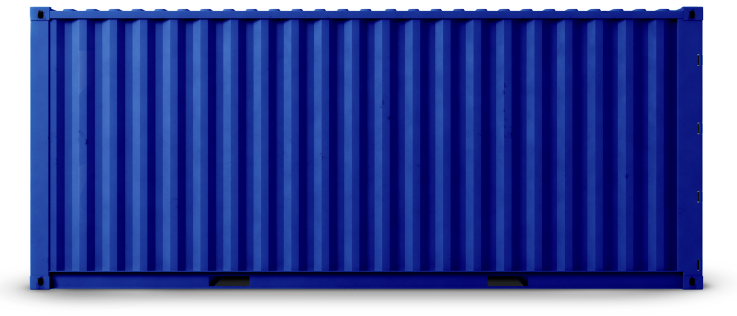
TEU (twenty-foot equivalent unit) is the standard unit used to measure container capacity. One 20-foot container (approximately 6 metres) counts as 1 TEU; a 40-foot container counts as 2 TEU. The term was introduced in the late 1960s. Since then, ports and shipping companies have been using the TEU to easily compare container flows and vessel capacity worldwide.
In 2026, we will celebrate the container. A quiet force behind our society and economy. Every container has a story behind it. It’s not just about everyday goods. It’s also about medical supplies being sent around the world. About components that contribute to sustainable energy. About factories delivered in parts. Stories about the economy, our daily lives and evolution. And in the coming period, we’d like to show you there’s more to it than meets the eye.
On average, around 14 million TEU containers pass through the port of Rotterdam each year, highlighting its role in international logistics. The import and export of containers is crucial for industry and consumers. If the supply of containers stops, the effects are quickly felt, from reduced availability of goods to delays in production. The security of supply in the Netherlands and Europe depends to a large extent on efficient and reliable container flows.
BELANGRIJKE ONTWIKKELINGEN SINDS 1966
How do the Dutch view containers?
Read the key findings from our public survey on the importance of containers and container logistics.
The container.
More than meets the eye.
It may well be one of the most influential objects, but we never give it a second thought: the container. It’s everywhere. But always in the background. Time to change that. We’re celebrating the container. And for good reason: sixty years ago, the port of Rotterdam welcomed its first container ship, the MS Fairland. The beginning of an evolution.
What was not regarded as a major event on 3 May 1966 turned out to be the start of a new logistics system for Europe. Thanks to the container, transport became faster, cheaper and more predictable. Container logistics plays a major role in shaping the world as we know it today, with global trade, well-stocked shops and a highly interconnected economy.
In 2026, we will celebrate the container. A quiet force behind our society and economy. Every container has a story behind it. It’s not just about everyday goods. It’s also about medical supplies being sent around the world. About components that contribute to sustainable energy. About factories delivered in parts. Stories about the economy, our daily lives and evolution. And in the coming period, we’d like to show you there’s more to it than meets the eye.
On average, around 14 million TEU containers pass through the port of Rotterdam each year, highlighting its role in international logistics. The import and export of containers is crucial for industry and consumers. If the supply of containers stops, the effects are quickly felt, from reduced availability of goods to delays in production. The security of supply in the Netherlands and Europe depends to a large extent on efficient and reliable container flows.
Read the key findings from our public survey on the importance of containers and container logistics.
How do the Dutch view containers?
TEU: the standard unit of measurement in the world of containers
TEU (twenty-foot equivalent unit) is the standard unit used to measure container capacity. One 20-foot container (approximately 6 metres) counts as 1 TEU; a 40-foot container counts as 2 TEU. The term was introduced in the late 1960s. Since then, ports and shipping companies have been using the TEU to easily compare container flows and vessel capacity worldwide.